
Kelly Brown feels safe in her neighborhood. She’s a single woman, but she knows her neighbors have her back. When she’s gone, she has a neighborhood watch making sure her valuables stay secure. They’re equally protective of her physical safety.
On May 12, Brown is being kicked out of her neighborhood, which just happens to be under the freeway at Hwy 59 and Commerce. Brown and her “neighbors” are homeless. And after May 12, it will be illegal to have homeless encampment in public places.
“These are the people who have kept me safe,” Brown said. “We set up these camps because there’s safety in numbers.”
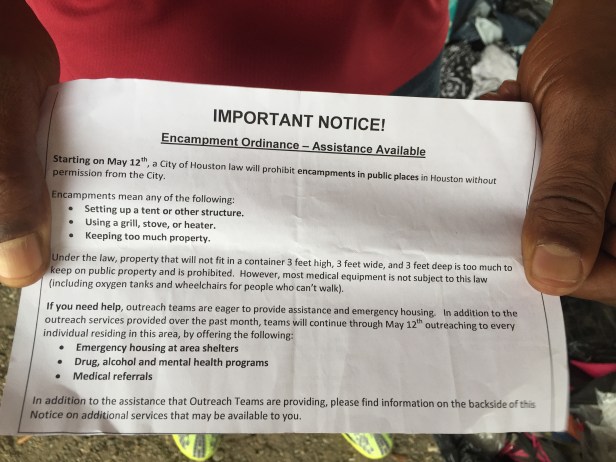
The law is aimed at eliminating these homeless “towns” where groups of people congregate and set up camps. Specifically, the law bans setting up a tent or other structure, using a grill, stove or heater, or keeping “too much property.” “Too much property” is defined as more than will fit in a 3x3x3 container.
Until now, her camp has been about as physically comfortable as you can get with no walls, central A/C or heat. She has two mats, pillows, several blankets, toiletries, beautiful clothing and shoes, costume jewelry, purses, bags and stuffed animals.
“I’m going to have to get rid of 9/10 of this,” Brown said, hurriedly shoving clothing into suitcases, bags and anything else she can get her hands on. She’s passing things out among the other homeless, taking some to shelters blocks away. “People spent their valuable resources to get these things for us. I don’t want to throw things away. That’s not what they intended when they gave it to me.”
Among the items she’s struggling to part with is her collection of paperback books. A former book store employee, Brown’s favorite activity is reading, particularly mysteries.
But while parting with possessions is hard, parting ways with the people you count on for your safety is far more difficult.

“This is home. We have nowhere else to go,” said another homeless woman, who simply goes by ‘T.’ “A lot of us have no families. They’ve disowned us.”
T is in the same encampment as Brown. T lives in a large tent with her husband. She is 5 months pregnant.
“My dad has a 4-bedroom house; my mom has a 5-bedroom house,” she said, tears escaping her eyes. “They don’t want to help me. This is my family.”
And when the baby comes in four months?
“He’ll live in the tent with us,” she said.
T and her husband have another location in mind. They, along with seven friends, plan to move to a more remote location and live in the woods behind a park. The woods has a creek where she says she can get fresh water each day. The park has shower facilities. But setting up a camp there isn’t any more legal. It’s just more hidden from sight.
Which seems to be the point. Downtown has become gentrified and the homeless camps don’t fit in with the new residents, Brown said.
“This is no longer just a business district. It’s become a residential district, too,” she said. “We’re not the right class…and probably not even the right color to be down here where they live.”
But moving presents multiple problems. While Mayor Sylvester Turner has spoken about his plan to address the need for more housing for the homeless, the homeless at Hwy 59 and Commerce haven’t been handed any keys. That means they remain homeless, but will have to do so without the tents and mattresses, the pillows and blankets, the spare clothes and shoes…..and anything else that doesn’t fit within a 3x3x3 container.
“They can’t make everyone move, just take our tents and property,” said Joe J. “And they’re doing it on May 12. That means most of us will still have about 20 days to go until we get our next check. We’ll be out here sleeping on cardboard.”
For many of the homeless, the first of the month represents a small influx of cash as they receive government checks. By the middle of the month, that money is usually gone.
Moving, as T and her adopted family intend, comes with additional problems. The resources are downtown. The current encampment is one block from Loaves & Fishes, a soup kitchen that provides lunch 6 days a week. The Beacon, which also serves meals, provides counseling, legal services, laundry services and more, is an easy walk. And countless organizations, such as Step Up Houston, regularly visit with food, clothing, toiletries, sleeping bags, blankets, coats and other crucial donations.
“There are other places, but you have to pay bus fare or train fare,” said Brown. “I’m not usually lucky enough to have that.”
The encampment has already shrunk nearly in half, with people leaving every day since the mayor’s office started distributing fliers.
“We know where we want to go,” said T. “But how are we supposed to get there. I have a tent with a full-sized bed in it.” We have no cars. We have nothing to pack our stuff up in. We have no way to get it there.”
And most have no idea where they can even go, though they’re certain they will eventually find one another again.
“People are spreading out everywhere,” Joe said. “When someone finds a new place that’s safe, we’ll probably all migrate there.”
For the next two days, it’s all about minimizing. Brown walks up and down the street, carrying load after load to the Star of Hope, hoping that they’ll get as much use and pleasure out of her belongings as she did.
“Getting rid of a bag of clothing is very painful,” Kelly said, pulling out a favorite shawl and wrapping it around her shoulders. “Look at how beautiful this is. I don’t want to lose it. This is just killing me. It’s so horrible.”
 Step Up Houston